
AI vs human appointment setter: cost, speed and show-up rate
AI or human appointment setter? A comparison with figures from studies: what each costs, how fast each replies and what raises your show-up rate.
An appointment setter, or setter for short, messages or calls new leads, checks whether they fit the offer and books the discovery call. A person can do this work, and so can software. Both cost money, and both have limits.
This comparison rests on figures you can check: official statistics, published studies and the legal position in the EU and Germany. Where no reliable data exists, the text says so. For context: we build an AI appointment setter ourselves with SetterMaxer, so we are not neutral. The strengths of human setters have their own section.
Key takeaways
- Cost: Skilled full-time call-centre staff in Germany earn a median of €2,922 gross a month (Federal Employment Agency, Entgeltatlas 2025). An AI setter costs €0 to €499 a month at SetterMaxer, depending on the number of leads; some other providers charge per conversation.
- Speed: Companies that tried to reach a lead within an hour were nearly seven times as likely to qualify it as companies that tried an hour later (Harvard Business Review, 2011). An AI replies within seconds to minutes, including at night and at weekends.
- Show-up rate: We found no reliable studies for sales calls. In medical studies, 78.6% of appointments were attended with a text reminder and 67.8% without one (Cochrane, 2013).
- Where people win: On the phone, with objections that need tact, and in channels your AI setter doesn’t cover, a good human setter is stronger.
- Recommendation: If your leads arrive in writing through forms, ads or WhatsApp, an AI handles first contact, qualification and reminders, and people run the calls. If they come in by phone or in a channel your AI setter doesn’t cover (at SetterMaxer, Instagram DMs for example), the human setter remains the better choice.
AI setter and human setter at a glance
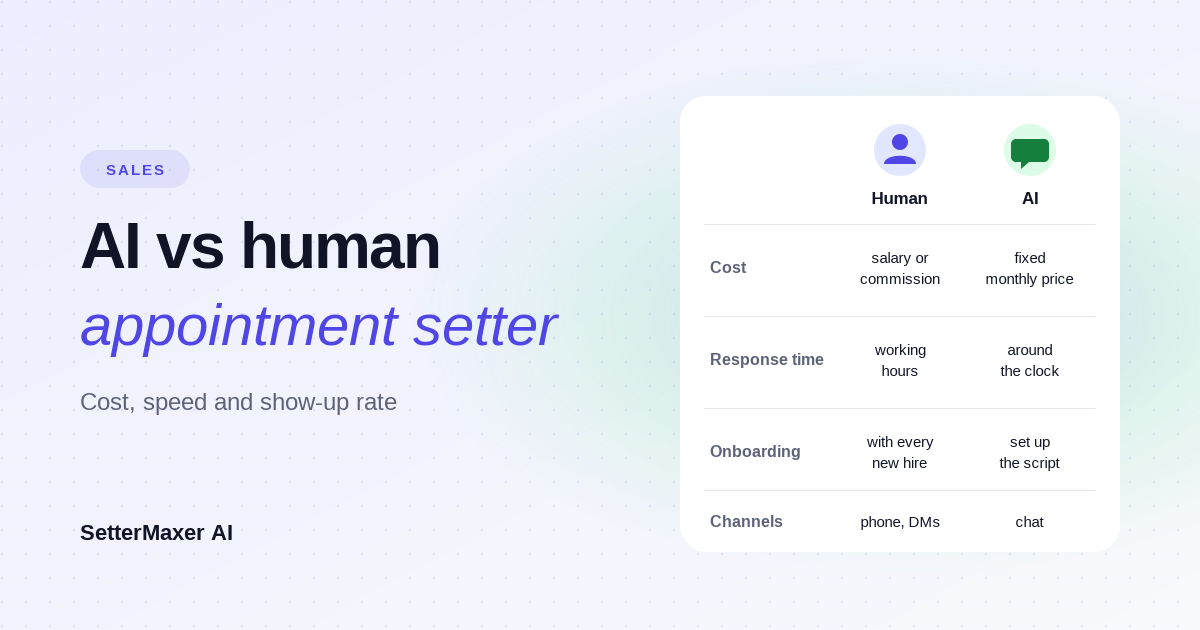
| Criterion | Human setter | AI setter |
|---|---|---|
| Cost | Salary or retainer, often plus commission | Depends on the provider; at SetterMaxer a fixed monthly price by lead volume |
| Response time | Minutes to hours, during working hours | Seconds to minutes, around the clock |
| Reminders before the call | By hand or automated through the booking tool, with a call the day before if you like | Run automatically for every appointment |
| Qualification | By script, depending on experience | The same criteria in every conversation |
| Channels | Phone, DMs, WhatsApp, email | Depends on the provider; at SetterMaxer WhatsApp and website chat |
| Onboarding | Weeks to months, again with every change of staff | Set up script and criteria, then refine them |
| Difficult conversations | Picks up on nuance and builds a relationship | Follows the script and hands over to a person |
The table sums up the sections below. For a more detailed comparison for coaching businesses, see our page on the AI appointment setter for coaches and consultants.
Cost: what a setter really costs per month
A human setter costs a salary or a fee every month; an AI setter costs a monthly price or a charge per conversation, depending on the provider. Which route is cheaper depends on how many leads you handle each month.
Employed setter
Germany’s Federal Employment Agency lists no occupation called “setter”. The closest match is the “dialogue marketing” occupational group, which includes call-centre agents and service chat agents. Skilled full-time staff in this group earn a median of €2,922 gross a month. The middle half earns between €2,433 and €3,786 (Federal Employment Agency: Entgeltatlas pay atlas, 2025 edition).
The floor is Germany’s statutory minimum wage. It has been €13.90 an hour since 1 January 2026 and rises to €14.60 in 2027 (German Federal Government). At 40 hours a week, €13.90 comes to about €2,409 gross a month. The minimum wage does not apply to the self-employed. Outside Germany, use your own country’s pay data for call-centre or customer service staff in the same way.
On top of the gross salary, you pay the employer’s social security contributions, holiday, sick days and a desk with equipment. And not every paid hour is an hour spent talking to leads: coordination, CRM upkeep and breaks are part of the job.
Freelance setter on commission
In coaching and agency sales, many setters are self-employed: on a retainer, a commission per appointment or per sale, or both. We found no reliable market data on typical rates. So get several quotes and do the sums with your own numbers.
With commission-only deals, watch the incentive. If you pay per booked appointment, appointments with leads who don’t fit also pay off for the setter. A commission per attended or qualified appointment is the better incentive.
Onboarding and turnover
Onboarding and turnover add to the running costs. We found no survey of this for Germany. The consultancy The Bridge Group regularly surveys B2B companies, mostly in North America. In the 2025 edition, with 351 companies, new sales development representatives (SDRs, who handle first contact and appointment setting in B2B sales) took an average of 3.0 months to reach full productivity and stayed in the role for an average of 1.9 years. Median annual attrition was 40%, of which 16 percentage points were promotions (The Bridge Group: SDR Models, Motions and Metrics Report 2025).
These figures come mostly from North American B2B sales and can’t be transferred directly to setters in coaching. We found no survey of whether setters in Germany change jobs as often. Still, budget for recruiting and onboarding again every time a setter leaves.
What an AI setter costs
How an AI setter is billed depends on the provider: a fixed monthly price, per conversation or per minute. At SetterMaxer it is a fixed monthly price with no commission: €0, €49, €199 or €499, depending on the plan, for 10, 50, 250 or 750 new leads a month (pricing).
Then there are the costs that appear on no price list:
- Setup: Script, qualification criteria and calendar have to be set up properly once.
- Oversight: Someone should read conversations regularly and refine the script.
- Mistakes in the conversation: An AI can misunderstand a question or give a wrong answer. Decide which topics it should hand over to you.
- Human work remains: The discovery call and every case the AI hands over still cost working time.
- WhatsApp number: If you don’t connect your own number, you rent one from SetterMaxer for €15 a month.
- Channel risk: If the AI setter runs on WhatsApp, it depends on the quality of your number. Our guide on how to protect your WhatsApp Business number from being banned explains how to prevent restrictions.
How to work out both routes
Don’t compare monthly costs. Compare the cost per attended discovery call:
Cost per attended appointment = monthly cost ÷ (booked appointments × show-up rate)
A worked example for an AI setter with assumed values, not figures from experience: a monthly cost of €499, 30 booked appointments and a 75% show-up rate give 499 ÷ (30 × 0.75), or about €22 per attended appointment. For a human setter, put in their full monthly cost and their own number of appointments. We found no reliable data on how many appointments a person and an AI book from the same leads. Only a test with your own leads will show that.
With few leads a month, a salaried setter is hardly kept busy, and the price per appointment goes up. A freelance setter paid per appointment doesn’t have this problem. With a very large number of leads, a team needs several setters, while with software the price rises with the plan or the number of conversations. The balance tips in favour of a person if you win your leads mainly by phone or in channels your AI setter doesn’t cover.
Speed: who replies faster?
On response time the AI is ahead, because it has no working hours. Whether that advantage matters depends on when your leads get in touch.
The best-known evidence for the value of fast replies is a study in the Harvard Business Review. The authors sent test enquiries to 2,241 US companies: 37% replied within an hour, 24% took more than 24 hours, and 23% never replied. Among the companies that replied within 30 days, the average was 42 hours.
In a second analysis of 1.25 million leads, companies that tried to contact a lead within an hour were nearly seven times as likely to qualify it as companies that tried an hour later. They were more than 60 times as likely as companies that waited 24 hours or longer. The authors counted a lead as qualified after a meaningful conversation with a key decision maker (Harvard Business Review: The Short Life of Online Sales Leads, 2011).
The study dates from 2011 and comes from the US. The size of the effects may be different today, but the connection is plausible: someone who has just sent a form still has their request in mind.
What this means for the comparison:
- Human setter: A setter with only a few open leads also replies within minutes during working hours. If the enquiry comes in at 10 pm or on a Sunday, the lead waits until the next working day.
- AI setter: The software messages new leads within seconds to minutes, whatever the time or day, and runs many conversations at once.
Speed alone is not enough. An instant message that doesn’t refer to the enquiry looks like advertising, and on WhatsApp you may only message leads who have given consent. Our guide on messaging email leads on WhatsApp shows what a good first message looks like.
Show-up rate: who gets more leads onto the call?
The show-up rate is the share of booked appointments the lead actually attends. We found no reliable study of sales calls on whether a human or an AI setter does better here. We left out percentages that come without a source and a method.
Missed appointments are well researched in medicine. Those results can’t be applied directly to discovery calls, but they show which levers work.
Reminders work, and a message works almost as well as a call
A Cochrane review analysed eight randomised trials with 6,615 participants (Cochrane Library: Mobile phone messaging reminders, 2013):
| Reminder | Share of patients who attended |
|---|---|
| No reminder | 67.8% |
| Text message | 78.6% |
| Phone call | 80.3% |
These rates are pooled across all included trials. Not every trial compared all three groups. In the direct comparison, text messages worked about as well as phone calls. In the two trials that also compared costs, they were cheaper per attended appointment than calls.
A second analysis of 21 studies reached a similar result: with a notification, 15% of patients stayed away without cancelling; without one, 21%. Several reminders raised attendance more than a single one. Voice notifications, such as calls, appeared more effective there than text messages (BMJ Open: Using digital notifications to improve attendance in clinic, 2016).
A short wait until the appointment
A review of 105 studies names the two factors most often linked to missed appointments: a long time between booking and appointment, and earlier no-shows by the same person (Health Policy: No-shows in appointment scheduling, 2018). So offer discovery calls within the next few days, not three weeks away.
What this means for setters
Reminders don’t depend on who booked the appointment. A human setter can automate them too, for example through the booking tool. Without automation, the difference is reliability: software sends every reminder at the set time, even with 40 appointments in a week. A person, on the other hand, can call the day before and hear in the conversation whether the lead is still interested.
From our own work we have individual reports, but no comparative study. Frohneck Immobilien, a German estate agency, reports a show-up rate of 95% after switching to automatic follow-ups on WhatsApp (AI WhatsApp chatbot for real estate agents). That is a single case without a comparison group, not a figure you should expect.
So measure your show-up rate yourself: attended appointments divided by booked appointments, split by lead source and by setter.
Where the human setter is ahead
A good human setter beats the AI in four situations.
On the phone. A field experiment with more than 6,200 customers compared sales calls made by chatbots and by people. Undisclosed bots sold as well as proficient workers. When customers were told before the conversation that a bot was calling, purchase rates fell by more than 79.7% (Marketing Science: Machines vs. Humans, 2019). According to the authors, customers saw the disclosed bot as less knowledgeable and less empathetic. The study covers calls with 2019 technology, not chats in which a lead got in touch first.
With problems and doubts. In a representative survey in Germany commissioned by the digital association Bitkom, 62% of online shoppers said that when they have a problem, they would most like to turn to a person who can be reached quickly. 36% wanted a chatbot (Bitkom, 2025). The survey was about customer service in online retail and did not cover appointment enquiries. Expect some leads to prefer a person for sensitive questions, and offer that option.
In channels your AI setter doesn’t cover. In coaching, many leads start in Instagram DMs, in comments or on the phone. A human setter works in all of these channels; an AI setter only in the ones its provider supports. At SetterMaxer these are WhatsApp and website chat.
With high-ticket offers and long decisions. Someone who is about to invest a five-figure sum has questions no script foresees. An experienced setter recognises what lies behind an objection and builds trust that carries through to the sales call.
Decision guide: when each setter fits
| Your situation | Recommendation |
|---|---|
| Leads come in through forms, ads or WhatsApp, often in the evening | AI setter |
| A few written leads a month, not enough for a permanent position | AI setter, or a freelance setter paid per appointment |
| Many similar enquiries with clear criteria | AI setter |
| Leads come mainly by phone or in channels your AI setter doesn’t cover | Human setter |
| High-ticket offer that needs explaining, few leads | Human setter |
| Many leads and an existing sales team | Combination |
In a combined setup, the AI messages every new lead, checks the criteria, books the appointment and sends a reminder before it. The human setter or closer takes the cases that need a conversation, and every channel the AI doesn’t work in. Our guide to AI lead qualification describes how pre-qualification in the chat works.
Legal: what applies to both setters
Two rules apply no matter who contacts your leads. This section is an overview, not legal advice, and local law may differ in your country.
- Consent: In the EU, direct marketing by electronic message generally needs the recipient’s prior consent under Art. 13 of the ePrivacy Directive, and national rules add to it. Rules for marketing calls made by a person differ between EU countries. In Germany, § 7 UWG requires prior express consent for marketing calls to consumers and for marketing by electronic mail; for calls to businesses, presumed consent is enough. The German rule covers a setter’s call just as it covers an AI’s message.
- Disclosing the AI: Art. 50 of the EU AI Act has applied since 2 August 2026. AI systems that interact directly with people must be designed so that the person is informed they are interacting with an AI, at the latest at the first interaction. The duty is on the providers of such systems and does not apply, among other cases, where it is obvious that the system is an AI (Art. 50 AI Act; official text on EUR-Lex).
So an AI setter that passes itself off as a person is not an option in the EU. Check with your provider that the AI identifies itself as an AI in its first message. The parity in the phone experiment only held for bots that did not identify themselves.
What SetterMaxer does and doesn’t do
SetterMaxer is an AI appointment setter for WhatsApp and website chat. This is what the software does:
- First contact: It messages new leads within seconds to minutes and replies around the clock. You can set a longer response time if you like. Either way, make sure your script has the AI introduce itself as a digital assistant.
- Qualification: In every conversation it checks your must-haves and deal-breakers, and only then offers an appointment.
- Booking: Appointments go into Google Calendar, Calendly or Acuity.
- Reminders and follow-ups: Before the appointment it reminds the lead on WhatsApp, for example 24 and 2 hours beforehand. Anyone who doesn’t book gets a follow-up message according to the rules you set.
- Handover: As soon as you or your team write in the chat, the AI pauses in that conversation.
This is what SetterMaxer doesn’t do:
- No calls and no Instagram DMs. The AI works in WhatsApp and in the chat widget on your website.
- No sales call. You or your closer run the discovery call.
- No show-up tracking. SetterMaxer does not detect whether someone attended the appointment.
- No consent check. It is up to you to check whether you may message a lead.
The page on the AI WhatsApp chatbot shows what this looks like in WhatsApp.
Frequently asked questions
How much does an appointment setter cost per month?
Germany’s official pay statistics have no separate category for setters. Skilled full-time call-centre staff in Germany earn a median of €2,922 gross a month, plus the employer’s social security contributions. Freelance setters usually work on a retainer, a commission or both, and we found no reliable market data on typical rates. An AI setter is billed per month, per conversation or per minute, depending on the provider; at SetterMaxer it costs €0 to €499 a month.
Can an AI setter replace a human setter?
For written enquiries on WhatsApp or website chat, yes: first contact, qualification, booking and reminders can be automated. Phone calls, channels your AI setter doesn’t cover (at SetterMaxer, Instagram DMs) and conversations that need a lot of tact stay with people. The two can be combined: the AI handles the first written contact, people handle everything after that.
Does an AI setter have to say that it is an AI?
In the EU, yes. Under Art. 50 of the AI Act, people must be informed at the latest at the first interaction that they are interacting with an AI system, unless that is obvious. The duty has applied since 2 August 2026.
How do I calculate my show-up rate?
Divide the number of attended discovery calls by the number of booked discovery calls. With 40 booked and 30 attended appointments, the show-up rate is 75%. Analyse it separately by lead source, because leads from an ad often behave differently from referrals.
Sources
All pages retrieved on 20 November 2026.
- Federal Employment Agency (Bundesagentur für Arbeit): Entgeltatlas, Callcenteragent/in (in German)
- German Federal Government: Mindestlohn 2026 auf 13,90 Euro erhöht (in German)
- The Bridge Group: SDR Models, Motions and Metrics Report 2025
- Harvard Business Review: The Short Life of Online Sales Leads
- Cochrane Library: Mobile phone messaging reminders for attendance at healthcare appointments
- BMJ Open: Using digital notifications to improve attendance in clinic
- Health Policy: No-shows in appointment scheduling, a systematic literature review
- Marketing Science: Machines vs. Humans: The Impact of Artificial Intelligence Chatbot Disclosure on Customer Purchases
- Bitkom: Press release on customer service in online shopping (in German)
- EUR-Lex: Directive 2002/58/EC (ePrivacy Directive)
- Gesetze im Internet: § 7 UWG (in German)
- Regulation (EU) 2024/1689 (AI Act): Art. 50; official text on EUR-Lex
Your AI setter on WhatsApp
SetterMaxer replies to every enquiry within seconds, qualifies against your criteria and books the right leads into your calendar.